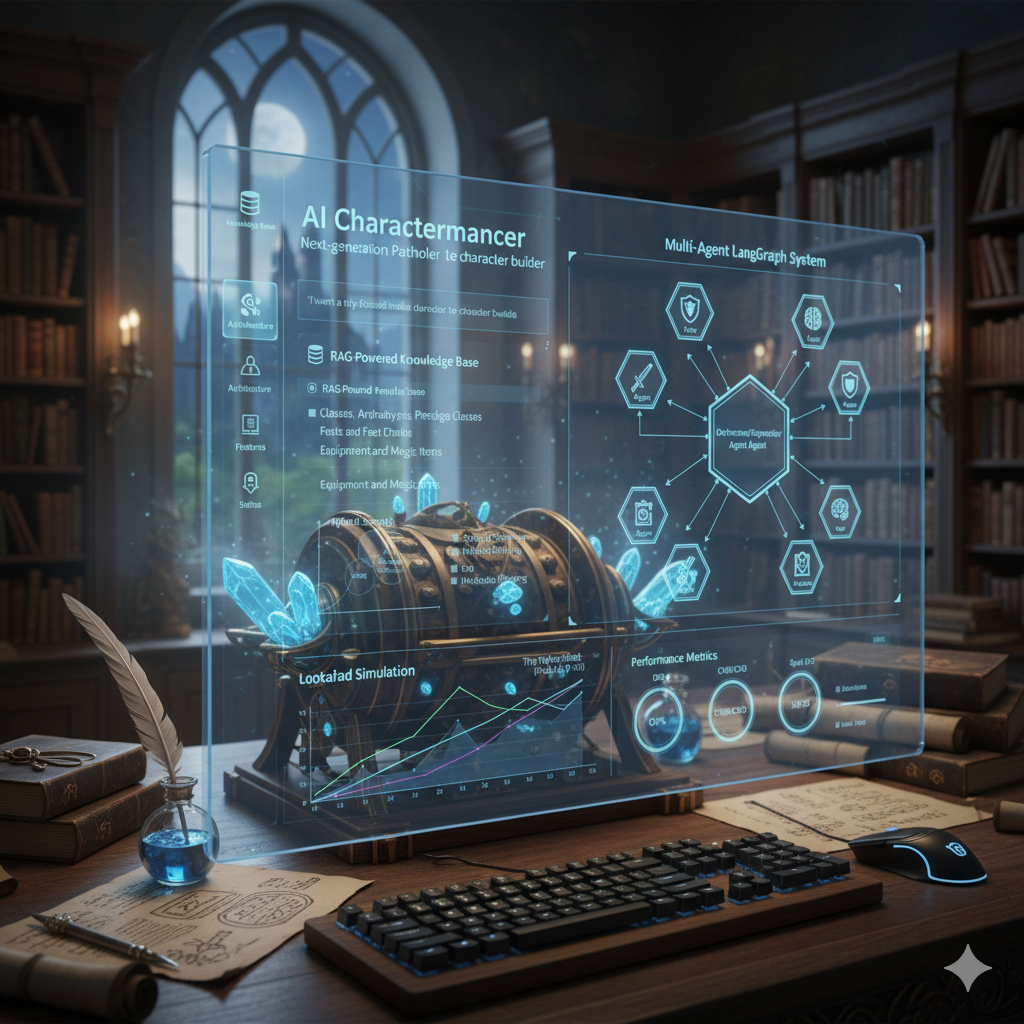
AI Charactermancer
Next-generation Pathfinder 1e character builder powered by AI and multi-agent optimization
python
ai
langgraph
Every game master knows the challenge: creating a living, breathing world where NPCs feel like real characters with their own motivations, relationships, and agency. Most NPCs are reactive props, waiting for players to interact with them. What if NPCs could live their own lives between sessions?
This incubation project explores using LangGraph to build a multi-agent system where each NPC becomes an autonomous agent with personality, goals, and the ability to interact with the world—and each other.
The system operates on a simple but powerful loop:
The magic happens when NPCs become actors in their own right:
LangGraph Multi-Agent System - Each NPC is represented as an autonomous agent with:
State Management - The world state tracks:
Natural Language Interface - Game masters interact with the system conversationally, describing events in plain language rather than filling out forms or managing complex configurations.
This project sits at the intersection of several fascinating domains:
AI & Game Design - Applying multi-agent systems and LLMs to solve a creative problem that has plagued tabletop RPGs for decades
Emergent Complexity - Simple rules for individual NPCs create complex, unpredictable world dynamics—exactly what makes great storytelling
Human-AI Collaboration - The system doesn’t replace the game master; it amplifies their creativity by handling the cognitive load of tracking dozens of NPCs and their motivations
Concept & Design Phase - This remains an incubation project, waiting for the right time to build. The architecture is clear, the tools exist (LangGraph, modern LLMs), and the use case is compelling. Sometimes the best projects are the ones you let marinate until you can give them the attention they deserve.
While designed for tabletop RPGs, the core concept—autonomous agents with personalities reacting to events and each other—has broader applications: